Der Sinn ist
.clone()stattnewzu verwenden, weil es performanter ist, und die initialen Objekte nie verändert werden.
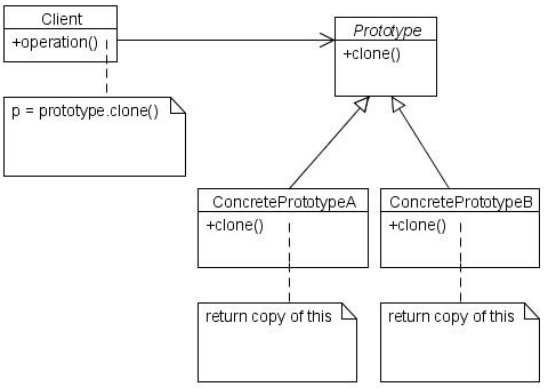
Mit Prototype Manager
Der PrototypeManager erstellt beim Programmstart von jedem ConcretePrototype ein Objekt, und gibt denen eine ID. Will man dann z.B. ein ConcretePrototypeA Objekt, macht man PrototypeManager.getObjectOfType('CPA'), dann returned der PrototypeManager ein geklontes Objekt vom originalen ConcretePrototypeA.
Geht auch ohne PrototypeManager zwischen Client und den ConcretePrototypes, taugt dann aber nix
Die Prototype Klasse ist dafür da um eine Map mit dem Datentypen Prototype im PrototypeManager zu halten.
Beispiel
Prototype
public abstract class ProductPrototype implements Cloneable{
	private String name;
	private Long produkt_nummer;

	@Override
	public ProductPrototype clone(){
		ProductPrototype clone = null;
		try{
			clone = (ProductPrototype) super.clone();
		}
		catch(CloneNotSupportedException e){
			e.printStackTrace();
		}
		return clone;
	}

	public Long getProdukt_nummer() {
		return produkt_nummer;
	}

	public void setProdukt_nummer(Long produkt_nummer) {
		this.produkt_nummer = produkt_nummer;
	}

	public String getName() {
		return name;
	}

	public void setName(String name) {
		this.name = name;
	}
}
PrototypeManager
enum VALID_PRODUCTS{
    CD,
    DVD,
    BUCH
}

public class PrototypeManager {
    HashMap<VALID_PRODUCTS, ProductPrototype> prototypeHashMap = new HashMap<>();

    public PrototypeManager(){
        prototypeHashMap.put(VALID_PRODUCTS.BUCH, new Buch());
        prototypeHashMap.put(VALID_PRODUCTS.CD, new CD());
        prototypeHashMap.put(VALID_PRODUCTS.DVD, new DvD());
    }

    public ProductPrototype getPrototype(VALID_PRODUCTS product){
        return prototypeHashMap.get(product).clone();
    }
}
DvD
public class DvD extends ProductPrototype{}CD
public class CD extends ProductPrototype{}Buch
public class Buch extends ProductPrototype{}