Aufbau der Bausteine
- Beschreibung 1.1. Einleitung 1.2. Zielsetzung 1.3. Abgrenzung und Modellierung
- Gefährdungslage 2.1. Spezifische Bedrohungen und Schwachstellen 2.2. …
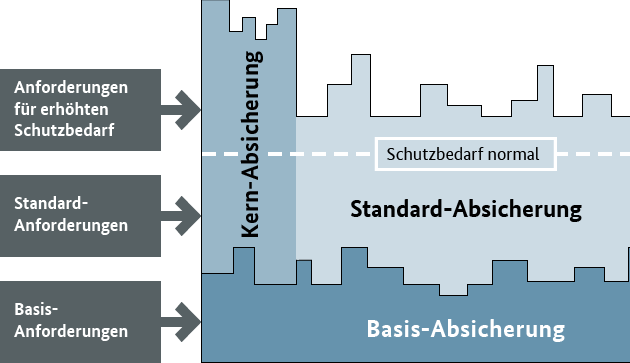
- Anforderungen 3.1. Basis Anforderungen 3.2. Standard Anforderungen 3.3. Anforderungen bei erhöhtem Schutzbedarf
- Weiterführende Informationen 4.1. Wissenswertes
Bedeutung der Schlüsselbegriffe
Diese Begriffe legen den Verbindlichkeitsgrad fest:
- MUSS (Basis Schutz) Zwingend umzusetzen. Keine Ausnahme zulässig. Nicht umgesetzt = Grundschutz nicht erfüllt.
- DARF NUR (Basis Schutz) Ausschließlich unter den genannten Bedingungen erlaubt.
- DARF NICHT / DARF KEIN (Basis Schutz) Striktes Verbot.
- SOLLTE (Standard/Hoher Schutz) Starke Empfehlung. Abweichung nur mit nachvollziehbarer Begründung.
- SOLLTE NICHT / SOLLTE KEIN (Standard/Hoher Schutz)
Klare Negativempfehlung, Abweichung nur in Ausnahmefällen.
MUSS = Pflicht, SOLLTE = dringend empfohlen.
Bausteine
ISMS: Sicherheitsmanagement
ORP: Organisation und Personal
ORP.1 Organisation
ORP.2 Personal
ORP.3 Sensibilisierung und Schulung zur Informationssicherheit
ORP.4 Identitäts- und Berechtigungsmanagement
ORP.5 Compliance Management (Anforderungsmanagement)
CON: Konzeption und Vorgehensweise
CON.1 Kryptokonzept
CON.2 Datenschutz
CON.3 Datensicherungskonzept
CON.6 Löschen und Vernichten
CON.7 Informationssicherheit auf Auslandsreisen
CON.8 Software-Entwicklung
CON.9 Informationsaustausch
CON.10 Entwicklung von Webanwendungen
CON.11.1 Geheimschutz VS-NUR FÜR DEN DIENSTGEBRAUCH (VS-NfD)
OPS: Betrieb
OPS.1.1.1 Allgemeiner IT-Betrieb
OPS.1.1.2 Ordnungsgemäße IT-Administration
OPS.1.1.3 Patch- und Änderungsmanagement
OPS.1.1.4 Schutz vor Schadprogrammen
OPS.1.1.5 Protokollierung
OPS.1.1.6 Software-Tests und -Freigaben
OPS.1.1.7 Systemmanagement
OPS.1.2.2 Archivierung
OPS.1.2.4 Telearbeit
OPS.1.2.5 Fernwartung
OPS.1.2.6 NTP -Zeitsynchronisation
OPS.2.2 Cloud-Nutzung
OPS.2.3 Nutzung von Outsourcing
OPS.3.2 Anbieten von Outsourcing
DER: Detektion und Reaktion
DER.1 Detektion von sicherheitsrelevanten Ereignissen
DER.2.1 Behandlung von Sicherheitsvorfällen
DER.2.2 Vorsorge für die IT-Forensik
DER.2.3 Bereinigung weitreichender Sicherheitsvorfälle
DER.3.1 Audits und Revisionen
DER.3.2 Revision auf Basis des Leitfadens IS-Revision
DER.4 Notfallmanagement
APP: Anwendungen
APP.1.1 Office-Produkte
APP.1.2 Webbrowser
APP.1.4 Mobile Anwendung (Apps)
APP.2.1 Allgemeiner Verzeichnisdienst
APP.2.2 Active Directory Domain Services
APP.2.3 OpenLDAP
APP.3.1 Webanwendungen und Webservices
APP.3.2 Webserver
APP.3.3 Fileserver
APP.3.4 Samba
APP.3.6 DNS-Server
APP.4.2 SAP-ERP-System
APP.4.3 Relationale Datenbanksysteme
APP.4.4 Kubernetes
APP.4.6 SAP ABAP-Programmierung
APP.5.2 Microsoft Exchange und Outlook
APP.5.3 Allgemeiner E-Mail-Client und -Server
APP.5.4 Unified Communications und Collaboration
APP.6 Allgemeine Software
APP.7 Entwicklung von Individualsoftware
SYS: IT-Systeme
SYS.1.1 Allgemeiner Server
SYS.1.2.2 Windows Server 2012
SYS.1.2.3 Windows Server
SYS.1.3 Server unter Linux und Unix
SYS.1.5 Virtualisierung
SYS.1.6 Containerisierung
SYS.1.7 IBM Z
SYS.1.8 Speicherlösungen
SYS.1.9 Terminalserver
SYS.2.1 Allgemeiner Client
SYS.2.2.3 Clients unter Windows
SYS.2.3 Clients unter Linux und Unix
SYS.2.4 Clients unter macOS
SYS.2.5 Client-Virtualisierung
SYS.2.6 Virtual Desktop Infrastructure
SYS.3.1 Laptops
SYS.3.2.1 Allgemeine Smartphones und Tablets
SYS.3.2.2 Mobile Device Management (MDM)
SYS.3.2.3 iOS (for Enterprise)
SYS.3.2.4 Android
SYS.3.3 Mobiltelefon
SYS.4.1 Drucker, Kopierer und Multifunktionsgeräte
SYS.4.3 Eingebettete Systeme
SYS.4.4 Allgemeines IoT-Gerät
SYS.4.5 Wechseldatenträger
IND: Industrielle IT
IND.1 Prozessleit- und Automatisierungstechnik
IND.2.1 Allgemeine ICS-Komponente
IND.2.2 Speicherprogrammierbare Steuerung (SPS)
IND.2.3 Sensoren und Aktoren
IND.2.4 Maschine
IND.2.7 Safety Instrumented Systems
IND.3.2 Fernwartung im industriellen Umfeld
NET: Netze und Kommunikation
NET.1.1 Netzarchitektur und -design
NET.1.2 Netzmanagement
NET.2.1 WLAN-Betrieb
NET.2.2 WLAN-Nutzung
NET.3.1 Router und Switches
NET.3.2 Firewall
NET.3.3 VPN
NET.3.4 Network Access Control
NET.4.1 TK-Anlagen
NET.4.2 VoIP
NET.4.3 Faxgeräte und Faxserver
INF: Infrastruktur
INF.1 Allgemeines Gebäude
INF.2 Rechenzentrum sowie Serverraum
INF.5 Raum sowie Schrank für technische Infrastruktur
INF.6 Datenträgerarchiv
INF.7 Büroarbeitsplatz
INF.8 Häuslicher Arbeitsplatz
INF.9 Mobiler Arbeitsplatz
INF.10 Besprechungs-, Veranstaltungs- und Schulungsraum
INF.11 Allgemeines Fahrzeug
INF.12 Verkabelung
INF.13 Technisches Gebäudemanagement
INF.14 Gebäudeautomation
Umsetzungshinweise
ISMS: Sicherheitsmanagement
ISMS.1 Sicherheitsmanagement PDF-Format / MS-Word-Format (Edition 2022)
ORP: Organisation und Personal
ORP.4 Identitäts- und Berechtigungsmanagement PDF-Format / MS-Word-Format (Edition 2022) ORP.5 Compliance Management (Anforderungsmanagement) PDF-Format / MS-Word-Format (Edition 2022)
CON: Konzeption und Vorgehensweise
CON.3 Datensicherungskonzept PDF-Format / MS-Word-Format (Edition 2022) CON.11.1 Geheimschutz VS-NUR FÜR DEN DIENSTGEBRAUCH (VS-NfD) PDF-Format / MS-Word-Format (Edition 2023)
OPS: Betrieb
OPS.1.2.2 Archivierung PDF-Format / MS-Word-Format (Edition 2022) OPS.1.2.4 Telearbeit PDF-Format / MS-Word-Format (Edition 2022) OPS.1.2.5 Fernwartung PDF-Format / MS-Word-Format (Edition 2022) OPS.2.1 Outsourcing für Kunden PDF-Format / MS-Word-Format (Edition 2022) OPS.3.1 Outsourcing für Dienstleister PDF-Format / MS-Word-Format (Edition 2022)
DER: Detektion und Reaktion
DER.3.2 Revisionen auf Basis des Leitfadens IS-Revision PDF-Format / MS-Word-Format (Edition 2022)
APP: Anwendungen
APP.4.2 SAP-ERP-System PDF-Format / MS-Word-Format (Edition 2022) APP.4.6. SAP ABAP-Programmierung PDF-Format / MS-Word-Format (Edition 2022)
SYS: IT-Systeme
SYS.1.2.2 Windows Server 2012 PDF-Format / MS-Word-Format (Edition 2022) SYS.1.7 IBM Z PDF-Format / MS-Word-Format (Edition 2022) SYS.2.4 Clients unter macOS PDF-Format / MS-Word-Format (Edition 2022) SYS.3.1 Laptops PDF-Format / MS-Word-Format (Edition 2022) SYS.4.1 Drucker, Kopierer und Multifunktionsgeräte PDF-Format / MS-Word-Format (Edition 2022) SYS.4.5 Wechseldatenträger PDF-Format / MS-Word-Format (Edition 2022)
IND: Industrielle IT
IND.1 Prozessleit- und Automatisierungstechnik PDF-Format / MS-Word-Format (Edition 2022) IND.2.1 Allgemeine ICS-Komponente PDF-Format / MS-Word-Format (Edition 2022) IND.2.2 Speicherprogrammierbare Steuerung (SPS) PDF-Format / MS-Word-Format (Edition 2022) IND.2.4 Maschine PDF-Format / MS-Word-Format (Edition 2022) IND.2.7 Safety Instrumented Systems PDF-Format / MS-Word-Format (Edition 2022)
NET: Netze und Kommunikation
INF: Infrastruktur
INF.1 Allgemeines Gebäude PDF-Format / MS-Word-Format (Edition 2022) INF.5 Raum sowie Schrank für technische Infrastruktur PDF-Format / MS-Word-Format (Edition 2022) INF.6 Datenträgerarchiv PDF-Format / MS-Word-Format (Edition 2022) INF.7 Büroarbeitsplatz PDF-Format / MS-Word-Format (Edition 2022) INF.8 Häuslicher Arbeitsplatz PDF-Format / MS-Word-Format (Edition 2022) INF.9 Mobiler Arbeitsplatz PDF-Format / MS-Word-Format (Edition 2022) INF.10 Besprechungs-, Veranstaltungs- und Schulungsräume PDF-Format / MS-Word-Format (Edition 2022) INF.13 Technisches Gebäudemanagement PDF-Format / MS-Word-Format (Edition 2022) INF.14 Gebäudeautomation PDF-Format / MS-Word-Format (Edition 2022)